


Practical burnout recovery for women in 2026: A guide without pressure.


Burnout isn't just being tired. It's not the same as having a stressful week or needing a good night's sleep. Burnout is a state of emotional, physical, and mental exhaustion caused by prolonged or excessive stress. It's what happens when you've been running on empty for so long that your tank isn't just low; it's corroded.
If you're reading this in 2026, you might be feeling this especially hard right now. There's something uniquely brutal about this moment. We're living through what researchers call a "supercycle of change" between economic volatility, rapid disruption of artificial intelligence, and global social tensions, our nervous systems are being asked to process an unprecedented amount of fear, uncertainty, and doubt. For women navigating midlife transitions, perimenopause, and the invisible labor of caregiving, the load can feel unbearable.

Burnout recovery is possible, even when you can't afford to quit your job, take a sabbatical, or spend a month at a wellness retreat. This guide offers practical, clinically-grounded steps that fit your real life, not a fantasy version of it.
Understanding burnout in midlife women
The World Health Organization officially recognized burnout syndrome in 2019 as an occupational phenomenon not a medical condition, but a serious syndrome resulting from chronic workplace stress that has not been successfully managed. Burnout isn't the same as depression, though they can feel similar. Depression affects all areas of your life and often includes feelings of worthlessness and hopelessness that persist regardless of circumstances. Burnout, on the other hand, is typically tied to specific situations usually work or caregiving roles and you might still feel okay in other parts of your life.
Common symptoms of burnout include:
Chronic fatigue that sleep does not fix
Irritability and a shorter fuse than usual
Lack of motivation, even for things you once loved
Emotional detachment or feeling numb
Sleep disturbances either sleeping too much or struggling to fall asleep
Difficulty concentrating or making decisions
Physical symptoms like headaches or stomach issues
If you're recognizing these symptoms in yourself, you're not alone. According to McKinsey's 2025 Women in the Workplace report, 60% of senior-level women report feeling frequently burned out the highest level ever recorded. WebMD Health Services research shows that burnout perceptions increased by over 25% from 2022 to 2024, with 82% of all employees now at burnout risk.
There's also a newer phenomenon called "quiet cracking" where high-achievers maintain their professional performance while experiencing significant internal distress. Research cited in Psychology Today suggests that 55% of the workforce is currently in this state. Those who are quietly cracking are 6.2 times more likely to slide into full clinical burnout.
Why does burnout hit harder in your 40s and 50s? The answer often lies at the intersection of perimenopause and chronic stress. Hormonal shifts during this transition can amplify anxiety, disrupt sleep, and make your nervous system more reactive to stress. When you combine this biological reality with the highest demands of your career and often peak caregiving responsibilities, you've got a perfect storm for burnout.
The nervous system perspective: Why rest alone is not enough
Recovering from burnout is similar to healing from a physical injury you need proper care, rest, and a clear treatment plan. But here's what many recovery guides miss: burnout isn't just about being tired. It's about nervous system dysregulation.

When you're under chronic stress, your hypothalamic-pituitary-adrenal (HPA) axis the system that manages your stress response gets stuck in the "on" position. Your body keeps pumping out cortisol and adrenaline, even when the immediate threat has passed. This is why you can sleep for eight hours and still wake up exhausted. Your body is still in survival mode.
The 42% rule for burnout recovery comes from research into sustainable performance. The concept suggests that once you're operating at 42% or less of your normal capacity due to burnout, you've crossed a critical threshold where continuing to push forward actually makes things worse rather than better. At this point, any additional effort doesn't produce meaningful results; it just deepens the burnout.
Think of it like a phone battery. When your phone drops to 40% or below, you start being more careful about how you use it, right? You might turn off certain features or put it in low-power mode. The 42% rule suggests we should apply similar logic to ourselves during burnout recovery. Pushing harder is like trying to charge your phone by using it more. It's counterproductive.
The honest timeline? Physiological recovery HPA axis recalibration, sleep restoration, and inflammatory reduction typically takes 3-12 months with appropriate intervention. The deeper work of addressing the patterns that drove the over-functioning may take longer. This isn't discouraging news. It's honest news. And recovery isn't a destination it's a process that starts producing noticeable improvements well before it's "complete."
At Daymark, we believe in relief over pressure. Our approach is grounded in the understanding that you can't hustle your way out of burnout. You need rhythm, not rigidity. Small steps, not overwhelming overhauls.
Building your burnout recovery rhythm
Most burnout recovery advice falls into two unhelpful categories: "just take a break" (impossible for most women) or "do this elaborate 12-step wellness protocol" (overwhelming when you're already depleted). What actually works is building a rhythm small, repeatable practices that signal safety to your nervous system without adding to your load.
We organize recovery around the Day/Night framework: supporting your energy and steadiness by day, and decompression and restoration by night.
Day practices for energy steadiness
Morning sunlight exposure. Within 30 minutes of waking, get 10-15 minutes of natural light. This helps regulate your cortisol awakening response, which sets the tone for your entire day. Even on cloudy days, outdoor light is significantly brighter than indoor lighting.
Micro-breaks as nervous system resets. You don't need a 30-minute meditation session. You need 2-minute resets between meetings. Try box breathing: inhale for 4 counts, hold for 4, exhale for 4, hold for 4. Repeat 3-5 times. This activates your parasympathetic nervous system the "rest and digest" mode.
The "one strength task" approach. Instead of fighting your energy all day, match your hardest tasks to your natural peaks. Most people have a cortisol peak 60-90 minutes after waking use this window for focused work that requires cognitive heavy lifting. Save routine tasks for your natural dip in early afternoon.
Boundary phrases that don't require over-explaining. Practice saying: "I can't take that on right now." "Let me check my capacity and get back to you." "That doesn't work for me this week." You don't owe anyone a dissertation on why you're saying no.
Night practices for restoration

Digital sunset. Create a 60-minute buffer before bed where screens go away. Blue light exposure disrupts melatonin production, and the content you consume keeps your nervous system alert. This isn't about perfection it's about creating a container for sleep.
Create a sleep sanctuary. Keep your bedroom cool (65-68°F), dark, and quiet. If you can't control the environment completely, use what you can: blackout curtains, a white noise machine, an eye mask. Your brain needs environmental cues that it's safe to let go.
Magnesium glycinate and L-theanine. These are two of the most research-backed supplements for sleep support. Magnesium glycinate helps calm the nervous system and supports GABA production. L-theanine promotes relaxation without drowsiness. Tart cherry and valerian root have also shown promise for sleep quality. Our Sleep Bites were formulated with all four ingredients magnesium glycinate, L-theanine, tart cherry, and valerian root in a chocolatey bedtime bite designed to support your rest ritual without adding another pill to your routine.
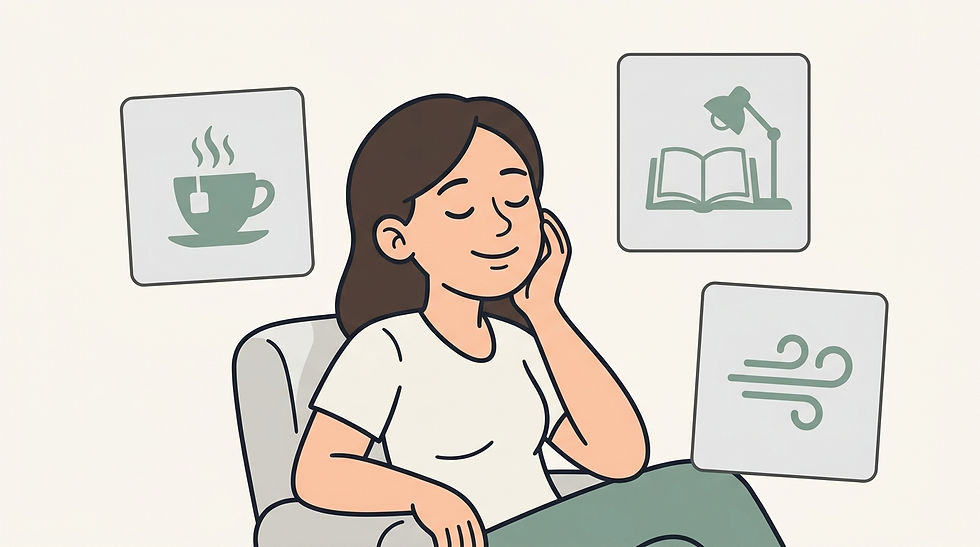
Evening rituals that signal safety. This might be a warm bath, gentle stretching, reading fiction (not work-related content), or a few minutes of journaling. The specific activity matters less than the consistency you're training your nervous system to recognize that the day is ending and it's safe to downshift.
Tiny steps that actually move the needle
The problem with most burnout recovery advice is that it adds to your burden. "Practice self-care Sundays!" "Meditate for 30 minutes daily!" "Overhaul your diet!" When you're already at 42% capacity, these well-meaning suggestions become another source of failure.
What actually works are micro-habits actions that take 5 minutes or less and can be done even on your hardest days. Here are evidence-based tiny steps:
Box breathing during transitions. Before you open your laptop, before you walk into a meeting, before you start your car. Just 60 seconds of regulated breathing signals safety to your nervous system.
Whispered self-validation. When pressure builds, take a breath and say: "This is hard, and I'm still showing up." Research cited in Psychology Today shows that people who acknowledge their emotions instead of hiding them experience 33% less severe quiet cracking.
The 3-minute reframe. Instead of asking "Why can't I handle this?" (which activates shame), ask "How am I managing to show up at all given the current circumstances?" (which activates self-compassion).
Make one specific request. Ask one colleague for one small thing five minutes of their time, help with one task, coverage for one meeting. Many women carry invisible labor because we never ask for help.
Stop the suppression tax. Give yourself five minutes in a quiet room to actually feel the frustration you've been hiding. Suppression has a physiological cost your nervous system works harder to maintain the facade.
Audit your "yes." Identify one thing you agreed to only to avoid appearing unprofessional. Plan a neutral way to decline next time.
Build a "do-not-do" list. What can you stop doing? What meetings can you decline? What expectations can you release? Creating bandwidth is just as important as adding recovery practices.
When you can't just take a break
Most burnout advice assumes you can step away: "Just take a break!" "Go on vacation!" "Practice self-care!" For most women, this advice feels about as helpful as being told to "just relax" when you're stressed. The reality is that most of us can't just walk away from our responsibilities.

So what do you do when you can't quit your job or take a sabbatical? You get strategic about scaling back without career sacrifice:
Audit the invisible labor. Women often carry emotional and logistical labor that never appears on performance reviews organizing team birthdays, taking notes in meetings, being the default for emotional support. Make the invisible visible. Which of these tasks can be shared, rotated, or simply stopped?
Micro-boundaries over grand gestures. Research on workplace recovery shows you might not be able to refuse all after-hours emails, but you can create a 15-minute buffer before lunch that's protected. You might not be able to skip that weekly meeting, but you can decline the optional ones. Small boundaries, consistently maintained, create more relief than one dramatic declaration that you can't sustain.
The influence question. When you feel overwhelmed, ask yourself: "What is one small thing I can actually influence right now?" This shifts you from helplessness (which activates more stress) to agency (which activates your prefrontal cortex).
Build a support network. This might include a therapist who understands burnout, a coach who can help you navigate workplace dynamics, or a small group of trusted friends who get it. You don't have to navigate this alone. Our wellness coaching at Daymark is designed for this exact intersection clinically grounded guidance for perimenopause, burnout, and stress that fits into real life, not fantasy life.
Finding relief that fits your real life
Burnout recovery isn't a destination it's a process with noticeable improvements along the way. You won't wake up one morning "cured." But you'll notice that you slept through the night. That you had one meeting without feeling like you were performing. That you said no to something and the world didn't end.
The principles are simple, even when the execution is not:
Small steps beat overwhelming overhauls
Rhythm beats rigidity
Self-compassion beats self-criticism (every time)
Boundaries protect your capacity to show up
Recovery happens in community, not isolation
You don't need to fix your entire life today. In fact, trying to do so often adds to the overwhelm. Pick one tiny step from this guide just one and practice it today. Not tomorrow. Not Monday. Not "when things slow down." Today.
At Daymark, we create products and coaching for women who are navigating these exact seasons. Our Sleep Bites support your evening wind-down ritual with ingredients chosen specifically for nervous system calming. Our wellness coaching offers clinically grounded guidance without the pressure disguised as wellness. We believe in relief, rhythm, and connection because that's what actually works.
Your body has been sending you signals. It's time to listen.
Frequently Asked Questions
How is practical burnout recovery for women in 2026 different from general burnout advice?
Women in 2026 face a unique intersection of challenges: post-pandemic workplace expectations, economic uncertainty, the rapid rise of AI disruption, and for many, perimenopause hitting during peak career demands. Recovery approaches need to account for hormonal transitions, the invisible labor women often carry, and the reality that most cannot simply take extended time off. The focus is on micro-recoveries that fit into real life, not wellness retreats.
What should women know about burnout recovery when they are also going through perimenopause?
Perimenopause and burnout share many symptoms sleep disruption, brain fog, irritability, fatigue and they amplify each other. Hormonal fluctuations during perimenopause can make your nervous system more reactive to stress, while chronic stress can worsen perimenopause symptoms. Recovery needs to address both: supporting hormone balance through sleep, blood sugar stability, and stress reduction while also doing the nervous system work of burnout recovery.
How long does practical burnout recovery for women in 2026 actually take?
Physiological recovery restoring sleep, calming the HPA axis, reducing inflammation typically takes 3-12 months with consistent intervention. The deeper work of changing the patterns that led to burnout may take 1-3 years. But here is the key: you will notice improvements along the way. Better sleep within weeks. More stable energy within months. The timeline is not about waiting to feel better; it is about gradual restoration.
Can you recover from burnout without quitting your job?
Yes, though it requires more intentional work. Recovery without a role change is possible if you can modify the conditions driving burnout: reducing scope, changing team dynamics, setting boundaries around after-hours communication, delegating invisible labor. Sometimes recovery reveals that the role itself is incompatible with your health but making that discovery with support is very different from making it in a breakdown.
What is the 42% rule and how does it apply to burnout recovery for women?
The 42% rule suggests that when you are operating at 42% or less of your normal capacity due to burnout, continuing to push forward makes things worse, not better. At this threshold, your priority needs to shift from output to restoration. For women who are used to performing at high levels despite depletion, this rule is permission to scale back strategically rather than pushing through until collapse.
What are the signs of 'quiet cracking' that women should watch for?
Quiet cracking is when you maintain professional performance while experiencing significant internal distress. Signs include: hitting all your deadlines while feeling hollow inside, showing up to meetings with a smile that feels like a performance, knowing something is 'slowly cracking' but being unable to name it, and suppressing your actual experience to appear professional. It is the exhausting act of appearing fine when you are not and it is 6.2 times more likely to lead to full clinical burnout.
How can functional foods like Sleep Bites support burnout recovery?
Sleep is the foundation of burnout recovery it is when your brain clears toxins, processes emotions, and restores your nervous system. Ingredients like magnesium glycinate and L-theanine support GABA production and relaxation without causing morning grogginess. Tart cherry provides natural melatonin. When these ingredients are combined in a simple, enjoyable format like a bedtime bite, they support a consistent evening ritual without adding another complicated supplement routine to your already-full plate.


Comments